Detection Performance Cryptography Radiation EDAC FPGA Co-Design Real-Time WCET NASA Telemetry Anti-Jamming Red Team ← Back to main site
Verified · Measured · Reproducible

Engineering
Evidence

Beyond the classifier, Quaranet is real cryptography, radiation-grade memory, an instruction-level timing proof, synthesizable silicon, and real spacecraft telemetry every figure produced by a script in research, reproducible end-to-end.

TECHNOLOGY READINESS · TRL-4.5
ROC-AUC 0.9911 Classify WCET 6,343 cyc RTL parity 8/8 SECDED self-heal Auth AES-256-GCM Real data NASA SMAP/MSL
SCROLL
00 · Detection Performance

Measured, not promised.

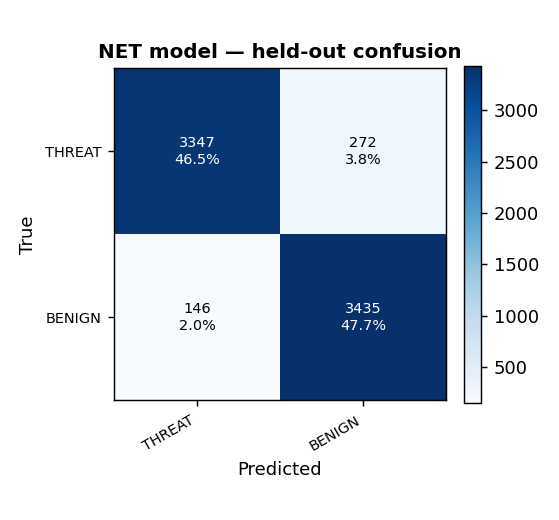
The binary HDC flight model on the real fused corpus (CICDDoS2019 + ToN-IoT, 1,327,989 packets), evaluated on a class-balanced held-out set of 7,200 the exact model running in the Rust core, bit-for-bit.

CONFUSION Held-out confusion matrix
Held-out confusion matrix · binary flight model (n = 7,200)
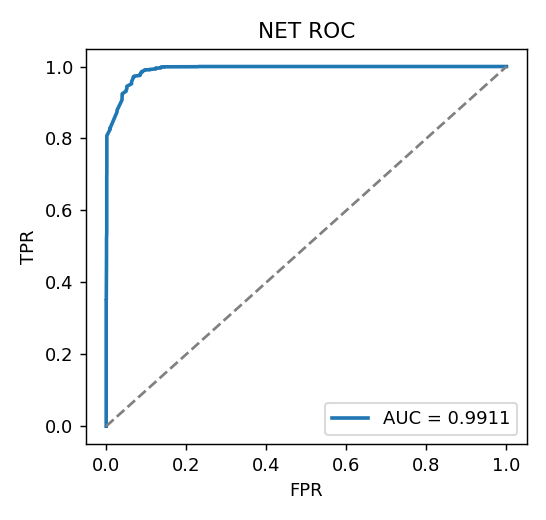
ROC · AUC 0.9911 ROC curve
Receiver-operating characteristic threshold-free separability
94.19%
Accuracy
95.82%
Precision
92.48%
Recall
4.08%
False-Positive
0.9911
ROC-AUC
01
01 · Cryptography · CCSDS 355.0-B

Authenticated Uplink
(AES-256-GCM)

The ground segment tags every frame with a 96-bit-nonce AES-256-GCM MAC; the flight core verifies it in constant time. Forged commands and replays are dropped before the HDC stage. Authentication is cryptographic, not statistical.

Unit-testedtampered frame & forged tag both rejected
SDLS GATE · LIVE TEST
$ cargo test sdls
✓ authentic frame → verified
✗ 1-bit tamper → REJECTED
✗ forged tag → REJECTED
✗ replayed seq → REJECTED
test result: ok. 0 failed
hover to flip ↻
GMAC

GCM authenticates each frame with a Galois-field MAC over a 96-bit nonce. Any bit flip, any forged tag, any stale sequence count fails verification in constant time the attacker never reaches the classifier.

verify() → {ok | drop} · constant-time
RustCrypto · no_std · allocation-free
02
02 · Radiation · Memory EDAC

Self-Healing
Model Memory

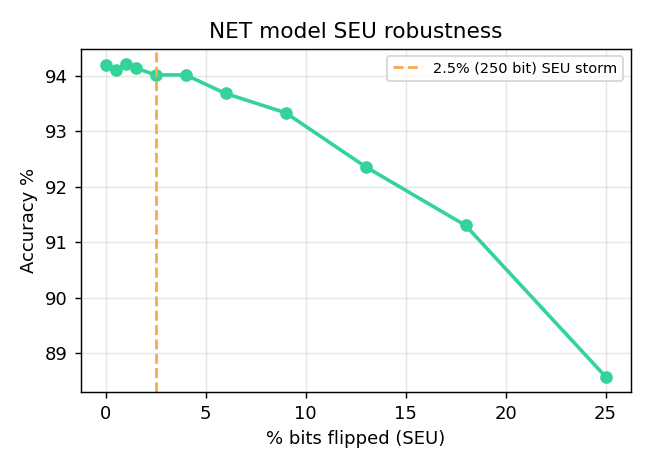
Every 64-bit class-prototype word carries a Hamming-SECDED code. A scrubber corrects single-bit upsets in place and refreshes double-bit faults from ROM the model heals itself. The 2.5% storm below is an accelerated margin test, orders of magnitude beyond the real on-orbit load (≲1 upset/day modeled).

Measured94% accuracy held under a 2.5% bit-flip storm
SEU ROBUSTNESS Accuracy vs SEU bit-flip rate
Detection accuracy vs single-event-upset bit-flip rate (accelerated margin test)
03
03 · Hardware · FPGA Co-Design

1-Clock Parallel
Hamming CAM

Synthesizable Verilog XORs the query against all class prototypes in parallel; combinational pop-count adder-trees feed a registered comparator. Latency is one clock, independent of the number of stored classes the true hardware O(1).

RTL simulation8/8 golden vectors match · single-clock latency
DATAPATH · 1 CLK
Query
10,048b
Prototypes
K parallel
POPCOUNT
adder-tree
argmin
comparator
▮ latency = 1 clock · K-independent
Combinational Hamming-CAM Verilog-2001, Zynq-synthesizable
04
04 · Real-Time · ARM Cortex-R5

Proven Worst-Case
Execution Time

Compiled for armv7r and counted at the instruction level. No division, no unbounded loop, no recursion the bound is exact and static, not "usually fast". This is the classify stage; the full pipeline is ~31 µs end-to-end with the model in TCM.

Static analysis≈ 6,343 cyc ≈ 10.6 µs @ 600 MHz · classify stage
CYCLE BUDGET
classify_net · Cortex-R5 @ 600 MHz
6,343 cyc · 10.6 µs
end-to-end (parse→encode→classify, TCM)
~31 µs · deterministic
Branch-free, data-independent path → provable WCET (no timing side-channel)
05
05 · Validation · Real Telemetry

NASA SMAP / MSL
Integration

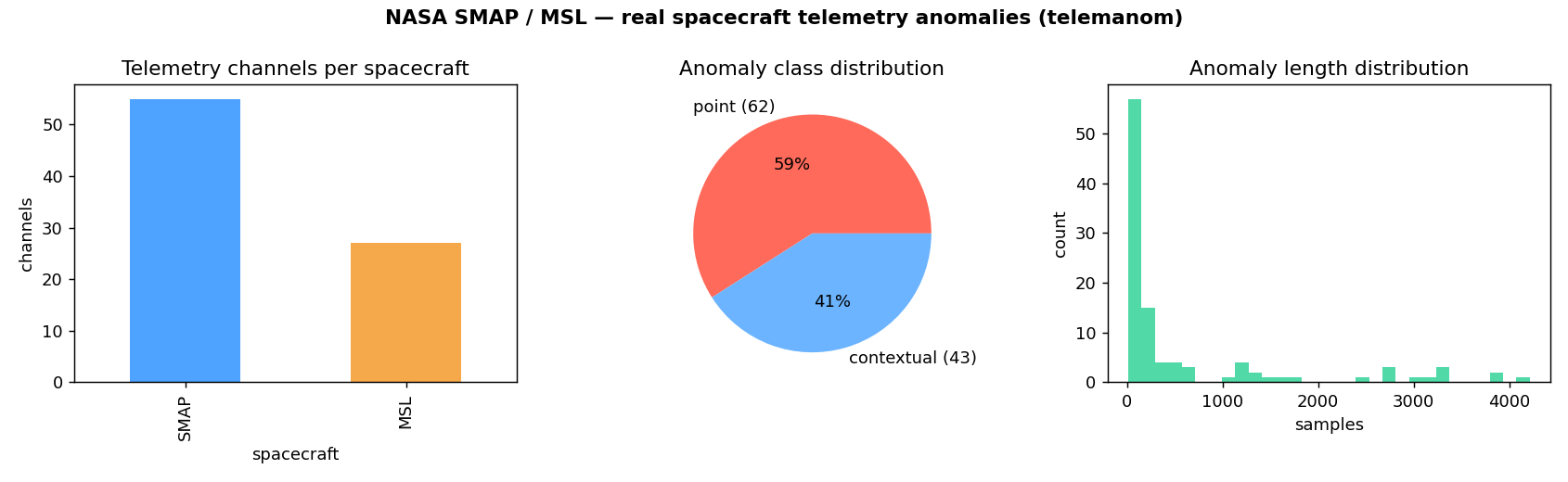
82 expert-labelled spacecraft telemetry channels (55 SMAP satellite + 27 MSL rover), 517,764 samples, 12.5% anomaly prevalence integrated alongside physics-based synthetic RF/TT&C data. Real spacecraft anomaly ground-truth, in the loop.

Real ground-truthNASA SMAP + MSL anomaly corpus in validation
NASA · TELEMANOM NASA SMAP/MSL telemetry anomaly corpus
Real NASA SMAP / MSL telemetry anomaly corpus (Hundman et al., telemanom)
06
06 · Signal · Anti-Jamming

RF Jamming
Classifier

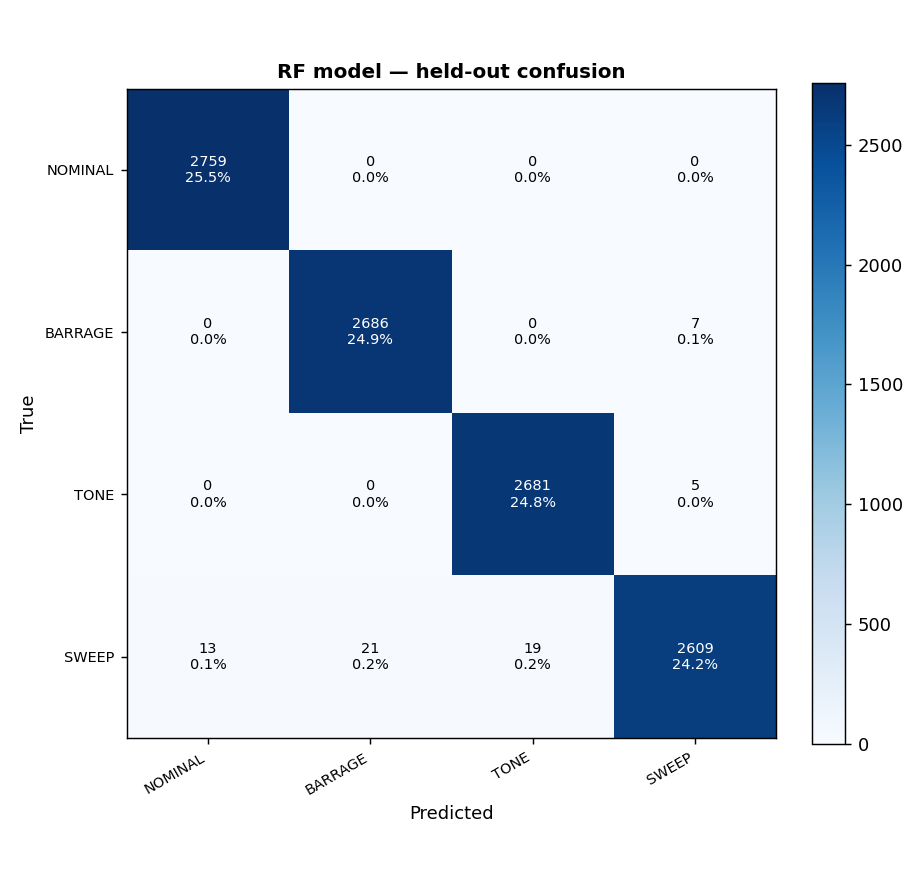
A second HDC model classifies the RF link (barrage / tone / sweep) from physics-based JSR/SINR features derived from the Friis link budget the same maths GNU Radio / STK integrate.

Held-out99.4% accuracy on RF link data (4-class)
RF · 4-CLASS RF jamming classifier confusion matrix
RF jamming classifier 4-class (physics-based synthetic, Friis/JSR/SINR)
07
07 · Red Team · Adversarial

We attacked
our own detector

A black-box evasion campaign against Quaranet and four baselines on the same frozen split: an attacker perturbs features within an L∞ budget, 60 label-only queries per sample, and wins if a malicious packet is called benign. At a realistic budget (ε=0.05) Quaranet is evaded 10.0% of the time versus 64.7% for a decision tree, 77.3% for a random forest and 100% for the quantised MLP. Because each feature is quantised to 32 levels, any perturbation that never crosses a boundary yields a bit-identical hypervector and provably cannot change the decision.

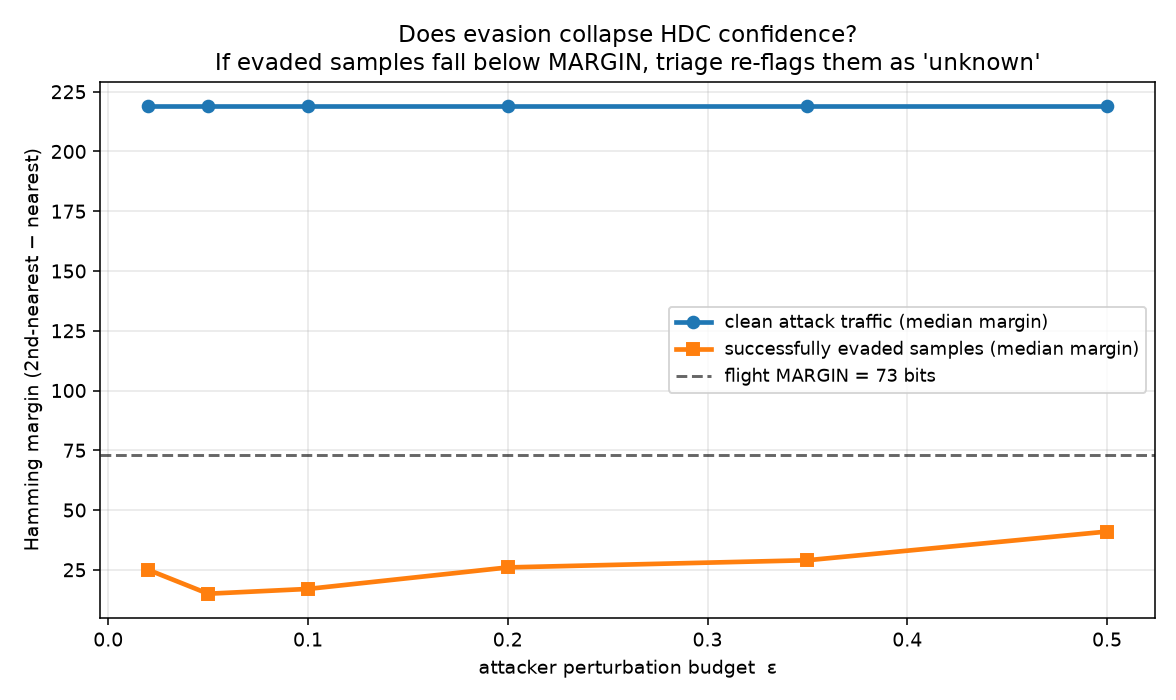
More useful than the win: every successful evasion collapsed the Hamming margin from a median of 219 bits to 15 100% landed below the flight MARGIN of 73, inside the “unknown” band. Evasion does not buy silence; it buys a low-confidence flag.

Self-red-teamed10.0% evaded at ε=0.05 · 100% of evasions fall below MARGIN

What went against us. Freezing the volumetric evidence an attacker cannot fake barely changed the result (10.0% → 8.7%), which means the model leans on forgeable header fields the same TCP artifacts our feature audit flagged. And at an unconstrained ε=0.5, every model tested is defeated, ours at 98.7%. We publish both numbers, because a red-team report that only contains good news is a marketing document.

MARGIN · COLLAPSE Hamming margin collapse under adversarial evasion
Successful evasions sit far below MARGIN=73 at every budget triage re-flags them
Mathematical Foundation

Why 10,000 dimensions.

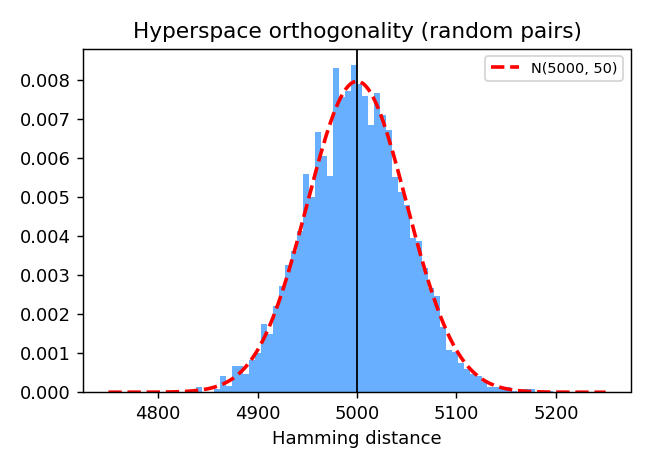
Two independent random hypervectors collide on ~D/2 bits with standard deviation √D/2. Noise and any learned threat are separated by ~5000 ± 50 random space has vanishing probability of resembling a threat.

N(5000, 50) Hyperspace orthogonality distribution
Random-pair Hamming distances measured ~ N(5000, 50) the separation guarantee, confirmed